Note
This notebook is located in the ./examples directory of the gwtransport repository.
Advection with Non-Linear Sorption#
This notebook provides a comprehensive guide to solving advection transport with non-linear sorption using the exact analytical front-tracking method.
The gwtransport package supports two non-linear sorption isotherms:
Freundlich isotherm: \(s(C) = k_f C^{1/n}\) — unbounded sorption capacity, widely used for organic contaminants and metals at moderate concentrations.
Langmuir isotherm: \(s(C) = s_{\max} \frac{C}{K_L + C}\) — bounded sorption with a maximum capacity, suitable when sorption sites saturate at high concentrations.
Both isotherms produce concentration-dependent retardation, leading to nonlinear wave behavior (shocks and rarefaction fans). The examples below use the Freundlich isotherm to illustrate wave physics; the Langmuir isotherm follows the same principles but always behaves as favorable sorption (higher \(C\) travels faster) because retardation monotonically decreases with concentration.
Table of Contents#
Theory
Governing Equation
Freundlich Sorption Isotherm
Langmuir Sorption Isotherm
Wave Types
Quick Reference Tables
Examples
Example 1: Concentration Pulse with Favorable Sorption (n > 1)
Example 2: Multi-Step Input with Wave Interactions
Example 3: Concentration Dip with Unfavorable Sorption (n < 1)
Comparison: Effect of Sorption Type on Wave Structure
Notes and Limitations
Theory#
Governing Equation#
The one-dimensional advection equation with sorption in pore volume coordinates \((V, t)\):
where:
\(C\) is dissolved concentration [mass/volume]
\(C_{\text{total}} = C + \frac{\rho_b}{\theta} s(C)\) is total concentration (dissolved + sorbed per unit pore volume)
\(Q\) is volumetric flow rate [volume/time]
\(V\) is cumulative pore volume [volume]
\(\rho_b\) is bulk density [mass/volume]
\(\theta\) is porosity [-]
\(s(C)\) is sorbed concentration [mass/mass of solid]
This is a hyperbolic conservation law with concentration-dependent wave speeds when sorption is non-linear.
Freundlich Sorption Isotherm#
The Freundlich isotherm relates sorbed and dissolved concentrations:
Parameter |
Symbol |
Units |
Description |
|---|---|---|---|
Freundlich coefficient |
\(k_f\) |
\((\text{m}^3/\text{kg})^{1/n}\) |
Sorption capacity |
Freundlich exponent |
\(n\) |
Isotherm curvature (n=1 is linear) |
|
Bulk density |
\(\rho_b\) |
kg/m³ |
Dry mass per bulk volume |
Porosity |
\(\theta\) |
Void fraction |
Retardation Factor#
The retardation factor \(R(C)\) relates pore water velocity to concentration velocity:
Key insight: For \(n \neq 1\), \(R\) depends on \(C\), creating concentration-dependent velocities:
Regime |
Condition |
Effect on \(R(C)\) |
Physical meaning |
|---|---|---|---|
Favorable |
\(n > 1\) |
\(R\) decreases with \(C\) |
Higher \(C\) travels faster |
Linear |
\(n = 1\) |
\(R\) constant |
All \(C\) travel at same speed |
Unfavorable |
\(n < 1\) |
\(R\) increases with \(C\) |
Higher \(C\) travels slower |
Langmuir Sorption Isotherm#
The Langmuir isotherm models sorption with a finite number of sites:
Parameter |
Symbol |
Units |
Description |
|---|---|---|---|
Maximum sorption capacity |
\(s_{\max}\) |
mg/kg |
Upper limit of sorbed mass per unit solid |
Half-saturation constant |
\(K_L\) |
mg/L |
Concentration at which \(s = s_{\max}/2\) |
Bulk density |
\(\rho_b\) |
kg/m³ |
Dry mass per bulk volume |
Porosity |
\(\theta\) |
Void fraction |
Retardation Factor#
Key properties:
\(R(0) = 1 + \frac{\rho_b \, s_{\max}}{\theta \, K_L}\) — always finite (no minimum-concentration threshold needed, unlike Freundlich with \(n > 1\))
\(R \to 1\) as \(C \to \infty\) (all sites saturated, no further retardation)
\(R\) always decreases with increasing \(C\) — the Langmuir isotherm is always favorable: higher concentrations travel faster
Because retardation monotonically decreases with concentration, concentration increases always form shocks and decreases always form rarefaction fans, matching the favorable (\(n > 1\)) Freundlich regime.
Wave Types#
At any instant, every concentration value travels at its own retarded speed \(\lambda(C) = Q / R(C)\). Conflicts between fast and slow values get resolved into one of three structures, depending on whether characteristics converge, diverge, or coexist:
Wave Type |
Visualization |
Mathematical Form |
Physical Process |
|---|---|---|---|
Characteristic |
Single line in V-t space |
\(\frac{dV}{dt} = \lambda(C)\) |
Smooth regions with constant C |
Shock |
Sharp front |
Rankine-Hugoniot: \(s = \frac{\Delta(QC)}{\Delta C_{\text{total}}}\) |
Compression: fast catches slow |
Rarefaction |
Expanding fan |
Self-similar: \(R(C) = \frac{Q(t-t_0)}{V-V_0}\) |
Expansion: slow follows fast |
Shock Velocity (Rankine-Hugoniot Condition)#
For a discontinuity between \(C_L\) (upstream) and \(C_R\) (downstream):
This ensures mass conservation across the discontinuity.
Entropy Condition (Lax)#
Physical shocks satisfy: \(\lambda(C_L) > s_{\text{shock}} > \lambda(C_R)\)
Characteristics must flow into the shock from both sides.
Quick Reference Tables#
Wave Formation Rules#
Favorable (\(n > 1\)) |
Unfavorable (\(n < 1\)) |
|
|---|---|---|
High C velocity |
Fast |
Slow |
Rarefaction when |
C decreases |
C increases |
Shock when |
C increases |
C decreases |
Breakthrough Curve Signatures#
Wave Type |
Breakthrough Appearance |
|---|---|
Shock |
Sharp, instantaneous change |
Rarefaction |
Gradual, smooth transition |
Characteristic |
Step change at arrival time |
Solver Properties#
Property |
Value |
|---|---|
Numerical dispersion |
Zero |
Mass balance precision |
Machine precision (~1e-14) |
Time stepping |
Event-driven (no fixed \(\Delta t\)) |
Solution type |
Exact analytical |
[1]:
import matplotlib.pyplot as plt
import numpy as np
import pandas as pd

from gwtransport.advection import infiltration_to_extraction_nonlinear_sorption
from gwtransport.fronttracking.plot import (
    plot_front_tracking_summary,
    plot_sorption_comparison,
)
from gwtransport.fronttracking.validation import verify_physics

plt.rcParams["figure.dpi"] = 100
plt.rcParams["font.size"] = 10

# Common parameters across all examples
bulk_density = 1500.0  # kg/m³
porosity = 0.3
Examples#
Example 1: Concentration Pulse with Favorable Sorption (\(n > 1\))#
A concentration pulse (\(0 \to 10 \to 0\)) demonstrates both shock and rarefaction formation.
Edge |
Transition |
Wave Type |
Reason |
|---|---|---|---|
Leading |
\(0 \to 10\) |
Shock |
Fast (\(C=10\)) catches slow (\(C=0\)) |
Trailing |
\(10 \to 0\) |
Rarefaction |
Slow (\(C=0\)) follows fast (\(C=10\)) |
[2]:
# Example 1: Setup
tedges_ex1 = pd.date_range(start="2020-01-01", periods=100, freq="D")
cin_ex1 = np.zeros(len(tedges_ex1) - 1)
cin_ex1[10:40] = 10.0  # Pulse from day 10 to 40

# Example 1 specific parameters
flow_ex1 = np.full(len(tedges_ex1) - 1, 100.0)  # m³/day
aquifer_pore_volume_ex1 = 200.0  # m³
freundlich_k_ex1 = 0.01  # (m³/kg)^(1/n)
freundlich_n_ex1 = 2.0  # n > 1 (favorable)

cout_tedges_ex1 = pd.date_range(start=tedges_ex1[0], periods=1350, freq="D")

print("Example 1: Concentration Pulse with Favorable Sorption")
print("  Inlet: 0 → 10 (day 10) → 0 (day 40)")
print(f"  Freundlich: n={freundlich_n_ex1}, k={freundlich_k_ex1}")
print(f"  Pore volume: {aquifer_pore_volume_ex1} m³")
Example 1: Concentration Pulse with Favorable Sorption
  Inlet: 0 → 10 (day 10) → 0 (day 40)
  Freundlich: n=2.0, k=0.01
  Pore volume: 200.0 m³
[3]:
# Example 1: Simulation
cout_ex1, structure_ex1 = infiltration_to_extraction_nonlinear_sorption(
    cin=cin_ex1,
    flow=flow_ex1,
    tedges=tedges_ex1,
    cout_tedges=cout_tedges_ex1,
    aquifer_pore_volumes=[aquifer_pore_volume_ex1],
    freundlich_k=freundlich_k_ex1,
    freundlich_n=freundlich_n_ex1,
    bulk_density=bulk_density,
    porosity=porosity,
)

print(
    f"Results: {structure_ex1[0]['n_events']} events | "
    f"{structure_ex1[0]['n_shocks']} shocks | "
    f"{structure_ex1[0]['n_rarefactions']} rarefactions | "
    f"First arrival: {structure_ex1[0]['tracker_state'].t_at_theta(structure_ex1[0]['theta_first_arrival']):.1f} days"
)

results_ex1 = verify_physics(structure_ex1[0], cout_ex1, cout_tedges_ex1, cin_ex1, verbose=True)
print(f"\n{results_ex1['summary']}")
Results: 3 events | 1 shocks | 1 rarefactions | First arrival: 43.6 days

All 7 physics checks passed
[4]:
# Example 1: Visualization
axes_ex1 = plot_front_tracking_summary(
    structure_ex1[0],
    tedges_ex1,
    cin_ex1,
    cout_tedges_ex1,
    cout_ex1,
    t_max=150,
    title="Example 1: Pulse with Favorable Sorption (n=2.0)",
)
plt.show()
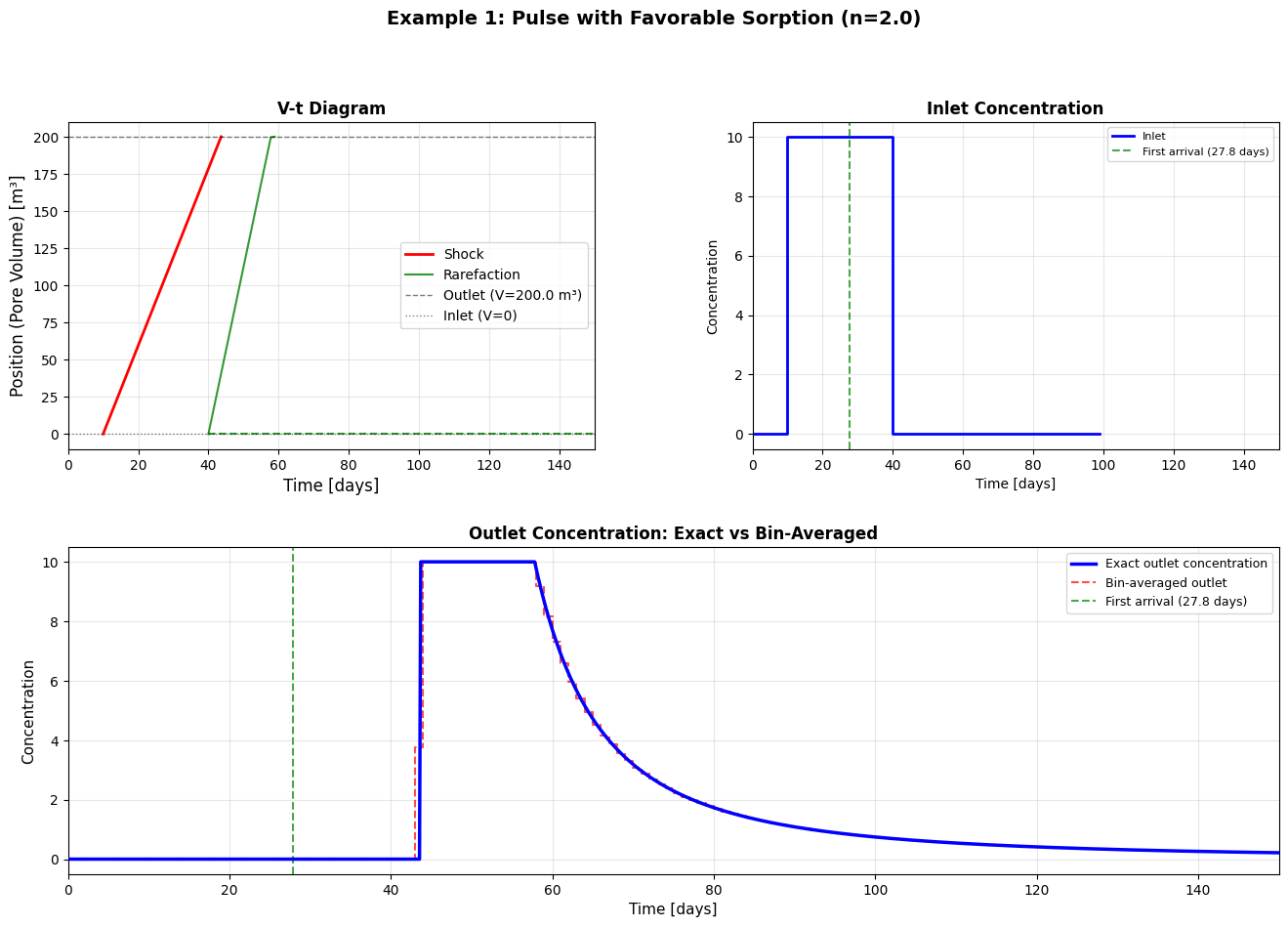
Interpretation: The V-t diagram shows the shock (red) on the leading edge and the rarefaction fan (green) on the trailing edge. The breakthrough curve exhibits a sharp rise followed by a gradual decline.
Example 2: Multi-Step Input with Wave Interactions#
Multiple concentration increases (\(0 \to 10 \to 15 \to 20\)) create interacting shock waves.
Step |
Transition |
Wave |
Interaction Potential |
|---|---|---|---|
1 |
\(0 \to 10\) |
Shock |
Base shock |
2 |
\(10 \to 15\) |
Shock |
Catches Step 1 (faster) |
3 |
\(15 \to 20\) |
Shock |
Catches Steps 1-2 (fastest) |
[5]:
# Example 2: Setup
tedges_ex2 = pd.date_range(start="2020-01-01", periods=101, freq="D")
cin_ex2 = np.zeros(len(tedges_ex2) - 1)
cin_ex2[10:50] = 10.0  # Step 1
cin_ex2[25:] = 15.0  # Step 2
cin_ex2[30:] = 20.0  # Step 3
cin_ex2[-1] = 0.0  # Return to baseline

# Example 2 specific parameters
flow_ex2 = np.full(len(tedges_ex2) - 1, 100.0)
aquifer_pore_volume_ex2 = 500.0
freundlich_k_ex2 = 0.01
freundlich_n_ex2 = 2.0

cout_tedges_ex2 = pd.date_range(start=tedges_ex2[0], periods=151, freq="D")

print("Example 2: Multi-Step Concentration Increases")
print("  Step 1 (day 10): 0 → 10")
print("  Step 2 (day 25): 10 → 15")
print("  Step 3 (day 30): 15 → 20")
print(f"  Pore volume: {aquifer_pore_volume_ex2} m³")
Example 2: Multi-Step Concentration Increases
  Step 1 (day 10): 0 → 10
  Step 2 (day 25): 10 → 15
  Step 3 (day 30): 15 → 20
  Pore volume: 500.0 m³
[6]:
# Example 2: Simulation
cout_ex2, structure_ex2 = infiltration_to_extraction_nonlinear_sorption(
    cin=cin_ex2,
    flow=flow_ex2,
    tedges=tedges_ex2,
    cout_tedges=cout_tedges_ex2,
    aquifer_pore_volumes=[aquifer_pore_volume_ex2],
    freundlich_k=freundlich_k_ex2,
    freundlich_n=freundlich_n_ex2,
    bulk_density=bulk_density,
    porosity=porosity,
)

print(
    f"Results: {structure_ex2[0]['n_events']} events | "
    f"{structure_ex2[0]['n_shocks']} shocks | "
    f"{structure_ex2[0]['n_rarefactions']} rarefactions | "
    f"First arrival: {structure_ex2[0]['tracker_state'].t_at_theta(structure_ex2[0]['theta_first_arrival']):.1f} days"
)

results_ex2 = verify_physics(structure_ex2[0], cout_ex2, cout_tedges_ex2, cin_ex2, verbose=True)
print(f"\n{results_ex2['summary']}")
Results: 5 events | 5 shocks | 1 rarefactions | First arrival: 94.1 days

All 7 physics checks passed
[7]:
# Example 2: Visualization
axes_ex2 = plot_front_tracking_summary(
    structure_ex2[0],
    tedges_ex2,
    cin_ex2,
    cout_tedges_ex2,
    cout_ex2,
    t_max=100,
    show_events=True,
    show_inactive=True,
    title="Example 2: Multi-Step Input with Wave Interactions (n=2.0)",
)
plt.show()
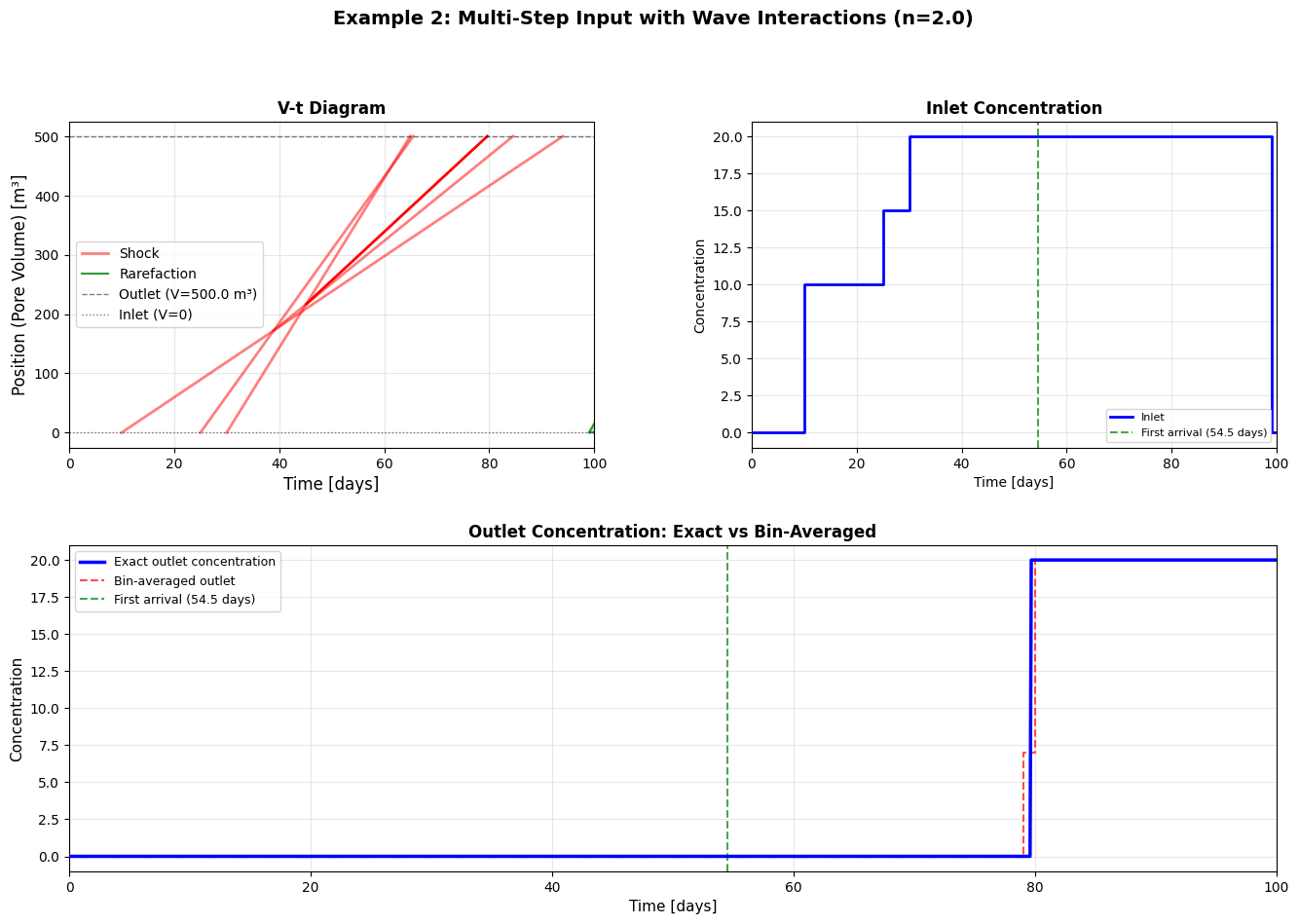
Interpretation: Event markers (×) show where faster shocks catch slower ones. The final breakthrough reaches \(C=20\), the maximum inlet concentration.
Example 3: Concentration Dip with Unfavorable Sorption (\(n < 1\))#
With \(n < 1\), the physics reverses: higher concentrations travel slower.
Property |
\(n > 1\) (Favorable) |
\(n < 1\) (Unfavorable) |
|---|---|---|
High C velocity |
Fast |
Slow |
Rarefaction from |
C decrease |
C increase |
Shock from |
C increase |
C decrease |
To demonstrate rarefactions with \(n < 1\), we use a concentration dip (\(10 \to 2 \to 10\)):
Edge |
Transition |
Wave Type |
Reason |
|---|---|---|---|
Leading |
\(10 \to 2\) |
Rarefaction |
Fast (\(C=2\)) outruns slow (\(C=10\)) |
Trailing |
\(2 \to 10\) |
Shock |
Slow (\(C=10\)) catches fast (\(C=2\)) |
[8]:
# Example 3: Setup
tedges_ex3 = pd.date_range(start="2020-01-01", periods=202, freq="D")
cin_ex3 = np.full(len(tedges_ex3) - 1, 10.0)  # Baseline
cin_ex3[:2] = 0.0  # Initial condition
cin_ex3[40:100] = 2.0  # Dip
cin_ex3[-1] = 0.0  # Explicit end for mass balance

# Example 3 specific parameters
flow_ex3 = np.full(len(tedges_ex3) - 1, 100.0)
aquifer_pore_volume_ex3 = 200.0
freundlich_k_ex3 = 0.001
freundlich_n_ex3 = 0.7  # n < 1 (unfavorable)

cout_tedges_ex3 = pd.date_range(start=tedges_ex3[0], periods=301, freq="D")

print("Example 3: Concentration Dip with Unfavorable Sorption")
print("  Inlet: 10 → 2 (day 40) → 10 (day 100) → 0 (day 200)")
print(f"  Freundlich: n={freundlich_n_ex3} (n < 1), k={freundlich_k_ex3}")
print("  Physics: High C = High retardation (SLOW)")
Example 3: Concentration Dip with Unfavorable Sorption
  Inlet: 10 → 2 (day 40) → 10 (day 100) → 0 (day 200)
  Freundlich: n=0.7 (n < 1), k=0.001
  Physics: High C = High retardation (SLOW)
[9]:
# Example 3: Simulation
cout_ex3, structure_ex3 = infiltration_to_extraction_nonlinear_sorption(
    cin=cin_ex3,
    flow=flow_ex3,
    tedges=tedges_ex3,
    cout_tedges=cout_tedges_ex3,
    aquifer_pore_volumes=[aquifer_pore_volume_ex3],
    freundlich_k=freundlich_k_ex3,
    freundlich_n=freundlich_n_ex3,
    bulk_density=bulk_density,
    porosity=porosity,
)

print(
    f"Results: {structure_ex3[0]['n_events']} events | "
    f"{structure_ex3[0]['n_shocks']} shocks | "
    f"{structure_ex3[0]['n_rarefactions']} rarefactions | "
    f"First arrival: {structure_ex3[0]['tracker_state'].t_at_theta(structure_ex3[0]['theta_first_arrival']):.1f} days"
)

results_ex3 = verify_physics(structure_ex3[0], cout_ex3, cout_tedges_ex3, cin_ex3, verbose=True)
print(f"\n{results_ex3['summary']}")
Results: 6 events | 2 shocks | 2 rarefactions | First arrival: 42.3 days

All 7 physics checks passed
[10]:
# Example 3: Visualization
axes_ex3 = plot_front_tracking_summary(
    structure_ex3[0],
    tedges_ex3,
    cin_ex3,
    cout_tedges_ex3,
    cout_ex3,
    t_max=250,
    title="Example 3: Dip with Unfavorable Sorption (n=0.7)",
)
plt.show()
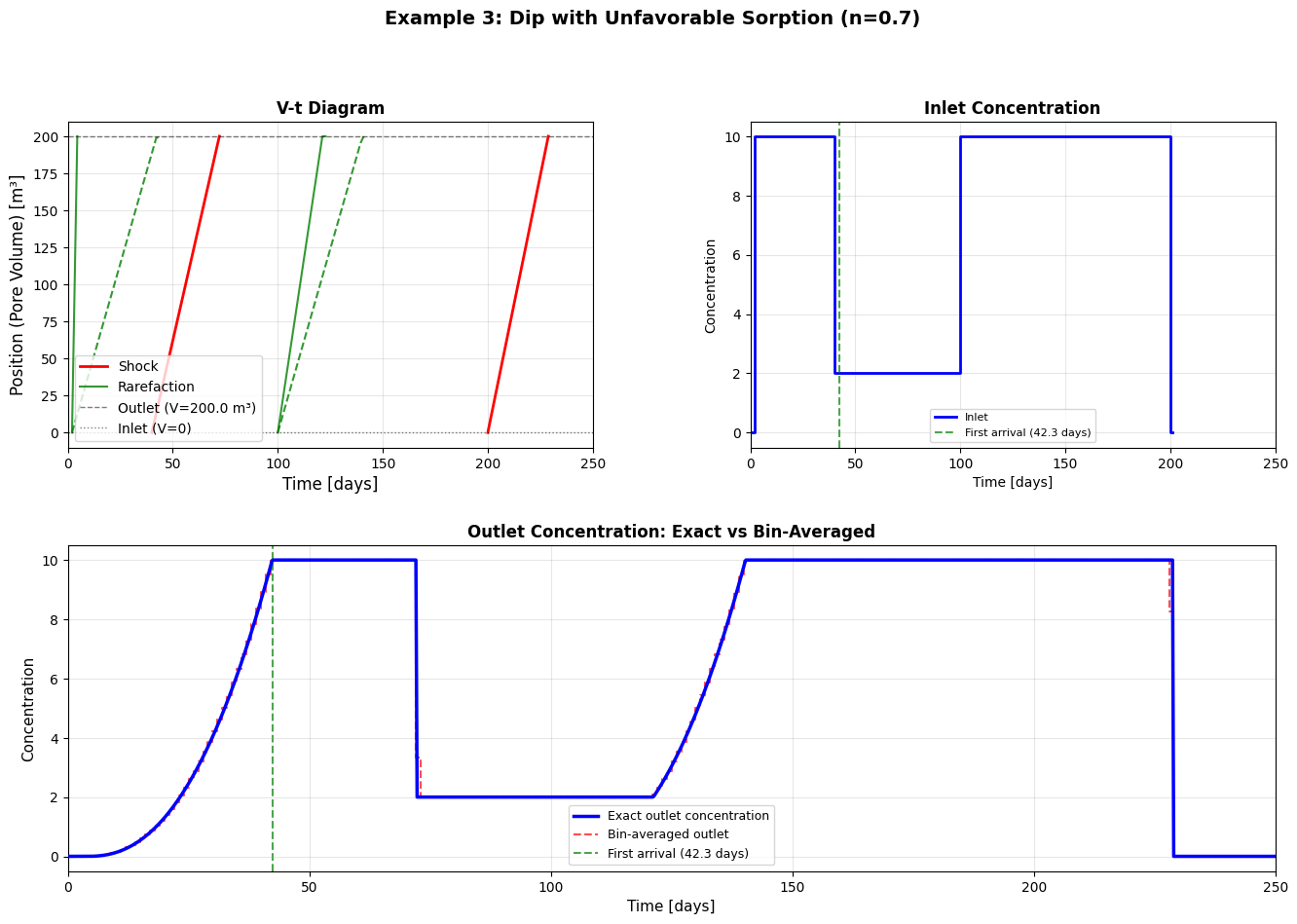
Interpretation: This is the mirror image of Example 1. The rarefaction fan (green) appears on the leading edge (\(10 \to 2\)), while the shock (red) appears on the trailing edge (\(2 \to 10\)).
Comparison: Effect of Sorption Type on Wave Structure#
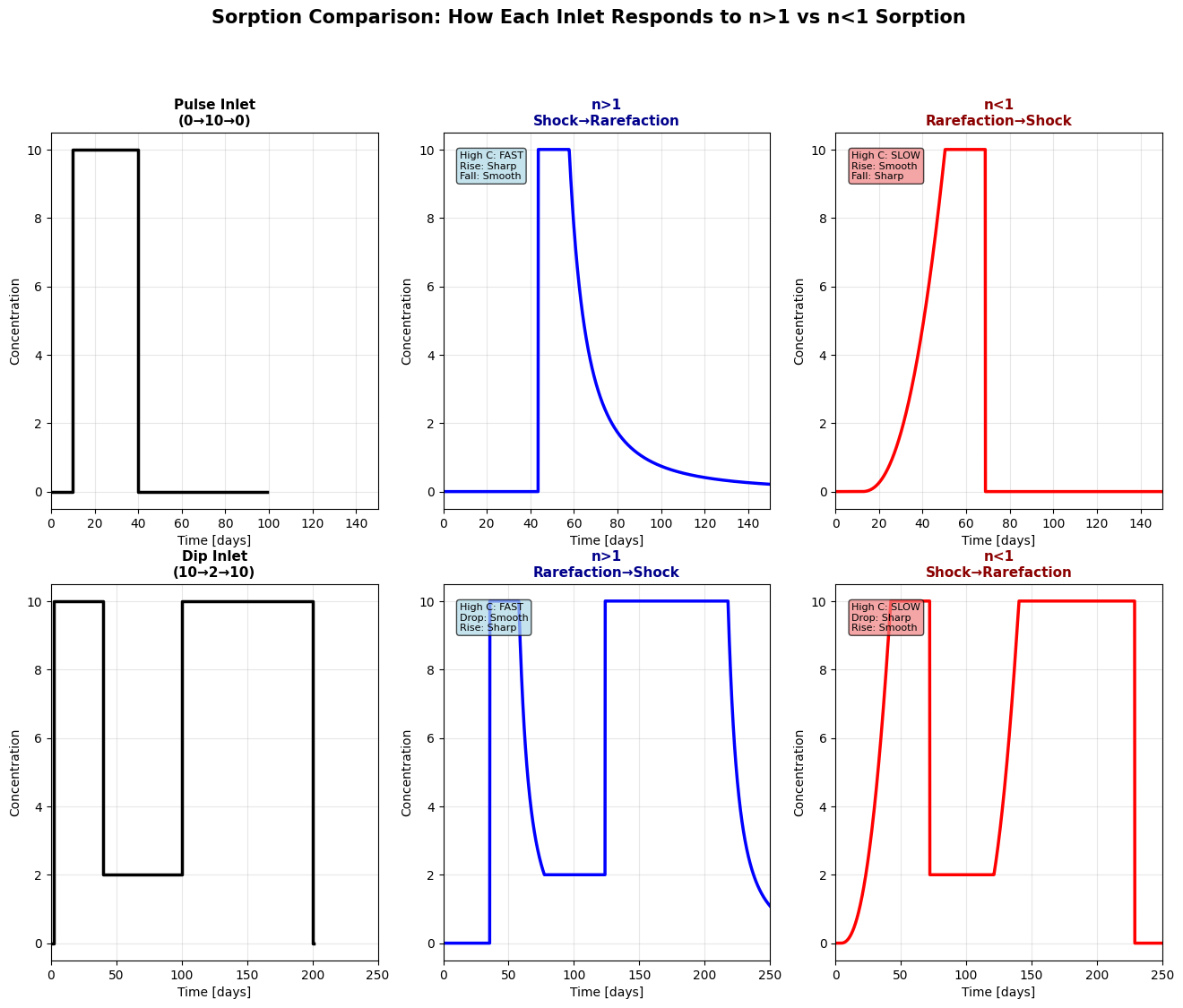
The same inlet pattern produces different wave structures depending on the sorption type.
Inlet |
Sorption |
Leading Edge |
Trailing Edge |
|---|---|---|---|
Pulse (\(0 \to C \to 0\)) |
Favorable (\(n>1\)) |
Shock |
Rarefaction |
Pulse (\(0 \to C \to 0\)) |
Unfavorable (\(n<1\)) |
Rarefaction |
Shock |
Dip (\(C \to c \to C\)) |
Favorable (\(n>1\)) |
Rarefaction |
Shock |
Dip (\(C \to c \to C\)) |
Unfavorable (\(n<1\)) |
Shock |
Rarefaction |
[11]:
# Cross-comparison: Run pulse with unfavorable and dip with favorable
print("Running pulse inlet with unfavorable sorption (n=0.7)...")
_, structure_pulse_unfav = infiltration_to_extraction_nonlinear_sorption(
    cin=cin_ex1,
    flow=flow_ex1,
    tedges=tedges_ex1,
    cout_tedges=cout_tedges_ex1,
    aquifer_pore_volumes=[aquifer_pore_volume_ex1],
    freundlich_k=freundlich_k_ex3,
    freundlich_n=freundlich_n_ex3,
    bulk_density=bulk_density,
    porosity=porosity,
)

print("Running dip inlet with favorable sorption (n=2.0)...")
_, structure_dip_fav = infiltration_to_extraction_nonlinear_sorption(
    cin=cin_ex3,
    flow=flow_ex3,
    tedges=tedges_ex3,
    cout_tedges=cout_tedges_ex3,
    aquifer_pore_volumes=[aquifer_pore_volume_ex3],
    freundlich_k=freundlich_k_ex1,
    freundlich_n=freundlich_n_ex1,
    bulk_density=bulk_density,
    porosity=porosity,
)
Running pulse inlet with unfavorable sorption (n=0.7)...
Running dip inlet with favorable sorption (n=2.0)...
[12]:
# Comparison plot
fig_comp, axes_comp = plot_sorption_comparison(
    pulse_favorable_structure=structure_ex1[0],
    pulse_unfavorable_structure=structure_pulse_unfav[0],
    pulse_tedges=tedges_ex1,
    pulse_cin=cin_ex1,
    dip_favorable_structure=structure_dip_fav[0],
    dip_unfavorable_structure=structure_ex3[0],
    dip_tedges=tedges_ex3,
    dip_cin=cin_ex3,
    t_max_pulse=150,
    t_max_dip=250,
)
plt.show()
Notes and Limitations#
Only a single compound can be simulated at a time and no chemical reactions are considered. Two nonlinear sorption isotherms are supported: the Freundlich isotherm (shown in the examples above) and the Langmuir isotherm. Other isotherms could be implemented without too much effort by subclassing NonlinearSorption.
To use the Langmuir isotherm, pass langmuir_s_max and langmuir_k_l instead of freundlich_k and freundlich_n to the front-tracking functions. See the API documentation for details.
The solver is exact analytical with no numerical dispersion or tolerance-based approximations and is event-driven to track wave interactions precisely. It is mass-conservative to machine precision (~1e-14) and performs physics verification (entropy conditions, arrival times, concentration bounds).
Background Reading#
For the theoretical foundation of non-linear sorption transport, see:
Non-Linear Sorption Concepts - Freundlich and Langmuir isotherms and front-tracking theory
Advection-Dominated Assumption - When diffusion/dispersion is negligible
Implementation Details#
For implementation details, see the API documentation:
gwtransport.fronttracking.math - Sorption models and shock/characteristic velocity
gwtransport.fronttracking.waves - Wave classes (Characteristic, Shock, Rarefaction)
gwtransport.fronttracking.solver - Event-driven simulation engine
infiltration_to_extraction_nonlinear_sorption - High-level API